I’m Not Working With Humans Anymore (Sadly)
Something subtle has changed in software development over the last couple of years. It’s not just “AI is helping” or “productivity is up.” It’s that I’m increasingly not interacting with people, at least not in the way I used to.
And yes, I mean that literally.
I still collaborate. I still work on teams. I still ship code. But the texture of day to day communication, the messy, biased, typo filled, human shaped texture, has started to disappear. What’s replacing it is clean, polite, templated, and eerily consistent.
If you write software, you probably know exactly what I’m talking about.
The pull request used to feel like a conversation
Let’s start with code reviews.
Not that long ago, a pull request was a small social event. Someone read your code, then left comments that revealed who they were:
They missed something obvious.
They over focused on a naming detail because that’s their pet peeve.
They wrote in broken English, or with spelling mistakes, or with too much sarcasm.
They got something wrong, and you debated it.
They asked a question that made you realize your code wasn’t clear.
That chaos was good.
It wasn’t efficient in the “machine optimized” sense, but it was rich in signals. You didn’t just receive feedback on code, you received feedback filtered through someone’s mind, experience, priorities, and mood. Sometimes that was annoying. Often it was valuable.
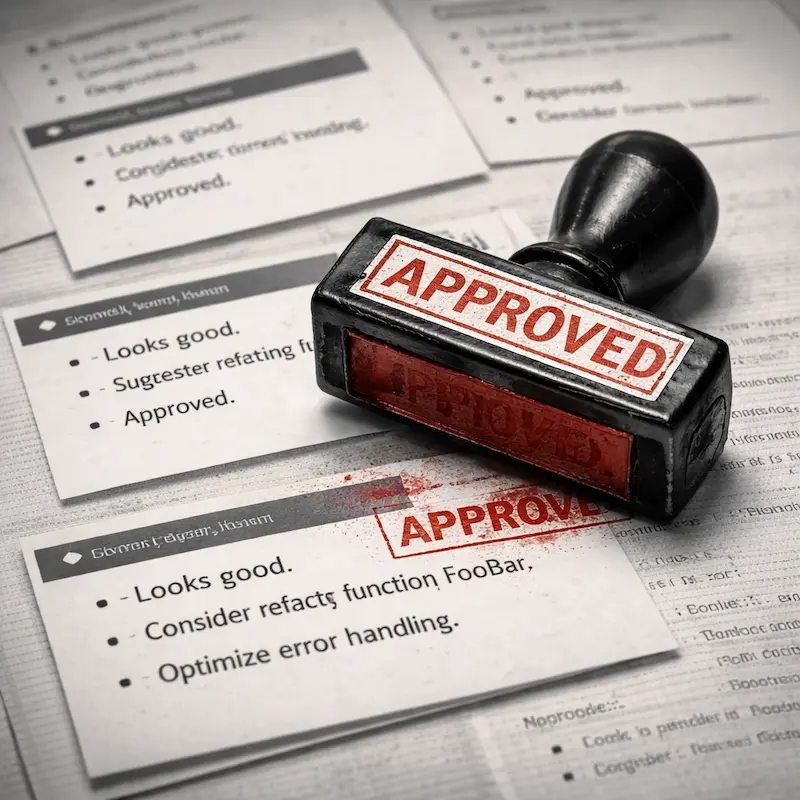
Now, I scroll through pull requests and I keep seeing the same shape:
A polite summary.
A numbered list of “potential improvements.”
A neutral tone.
A suspiciously balanced structure: “Pros,” “Cons,” “Suggestions,” “Conclusion.”
A couple of safe comments that could apply to almost any diff.
It’s not that the feedback is bad. It’s that the feedback doesn’t feel owned by a person.
And after you’ve read enough of these, you start seeing the repeating pattern on the page like a watermark.
The pattern recognition moment: “this wasn’t written by you”
There’s a specific point where your brain flips a switch.
You’re reading an approval message and you realize:
The phrasing is too smooth.
The caution is too evenly distributed.
The suggestions are technically correct but emotionally hollow.
The author’s voice is missing.
Even when a teammate did read your code, they often pass their thoughts through an AI agent. So what you receive is not their raw thinking, it’s their thinking laundered into a standardized format.
That’s the part that makes me sad.
Not because I want people to write with bad grammar. Not because I’m nostalgic for chaotic reviews. But because those imperfections were proof of presence. Proof that someone actually sat with your work and reacted to it as themselves.
Now, what I often get back is “a reasonable review,” not “your review.”
When AI starts doing what you used to do, your job definition shifts
Here’s the uncomfortable thought that follows.
If a significant chunk of review feedback is now generated, summaries, risk checks, style suggestions, test reminders, then that work has become commoditized. Not worthless, but replaceable. A default.
And if that work is replaceable, then it’s reasonable to expect that:
Fewer humans will be paid to do it.
The humans who remain will be pushed toward higher leverage work.
The definition of “senior” will drift away from execution and toward judgment.
This isn’t a doomsday prediction. It’s just the direction of the slope.
So I’ve been adjusting my own focus accordingly, less time optimizing for “task execution,” more time optimizing for:
ideation,
context understanding,
product thinking,
dealing with humans,
and engineering as a human system, not just a technical one.
Ironically, as AI makes the technical output easier, the human layer becomes the differentiator, because it’s the part that still can’t be faked reliably.
The strange result: we’re surrounded by words, but starved of people
Software work has always been communication heavy. But now it’s becoming communication heavy in a very specific way: lots of text, less humanity.
And it’s not just PRs.
You see it in:
issue comments,
design docs,
Slack messages that read like mini press releases,
customer support replies that feel “helpful” but not personal,
community posts that are optimized but generic.
In some spaces, it’s getting hard to tell whether you’re interacting with a person, a person with an AI, or a fully automated system.
And once that ambiguity becomes normal, you unconsciously start treating everything as non human. You stop engaging. You stop challenging. You stop adding nuance. You stop writing like a person too, because why bother?
That’s the real danger: not that AI writes, but that humans stop showing up.
Even platforms like Reddit start to feel different when half the answers have the same voice. The internet becomes a hall of mirrors: content reflecting content, style reflecting style, everything converging toward the same safe center.
“But isn’t this better?” Yes. And also no.
Practically speaking, AI mediated communication is often:
faster,
clearer,
more complete,
less hostile,
less error prone.
Those are real wins. I don’t want to go back to the era of cryptic one liners and passive aggressive code review comments.
But there’s a trade:
When everything is clean, nothing is memorable.
When everything is neutral, nothing feels true.
When every comment is “well structured,” you lose the signal of what someone actually cares about.
Human communication is not just about transferring information. It’s about transferring priorities, taste, and intent. That’s what makes collaboration effective over time.
AI can produce great text. But it tends to sand down the edges, the edges that reveal the person.
What I’m doing about it (practical, not philosophical)
I’m not interested in complaining. I’m interested in adapting without losing what matters.
Here’s what I’m trying to do, concretely:
1) I write “human first” in reviews (even if I used AI)
If I use AI to help structure feedback, I still add:
one blunt opinion,
one context specific observation,
one question that proves I read the code carefully.
Something only I would say.
2) I push conversations upstream
If a PR review becomes generic, I don’t fight it in the comments. I schedule a 10 minute chat, or I ask a pointed question that requires real context.
Not everything should be text. Text is where automation thrives.
3) I invest more in judgment than output
If AI can generate implementation options, my value is increasingly in:
picking the right option,
knowing what not to build,
understanding constraints that aren’t in the prompt,
anticipating second order effects.
That means spending more time with stakeholders, users, and teammates, and less time polishing tasks that a machine will soon do faster anyway.
4) I treat “taste” as a skill
Taste sounds vague, but it’s measurable in practice:
how you simplify APIs,
how you trade off performance vs. maintainability,
how you name things,
how you design failure modes,
how you explain decisions.
AI can imitate taste. It can’t develop it for you. Taste comes from caring, and from consequences.
The core feeling, in one sentence
I’m not working with humans anymore, sadly, not because humans are gone, but because their presence is being filtered into a default voice.
And that voice is competent, polite, and empty.
I don’t think the solution is to reject AI. The solution is to refuse to disappear behind it.
If we’re going to use these tools, and we are, then we should use them to amplify our intent, not replace our participation.
Because the future isn’t “humans vs. AI.”
It’s “humans who still show up” vs. “humans who outsource their voice.”
And I know which side I’m choosing.